

Event Details
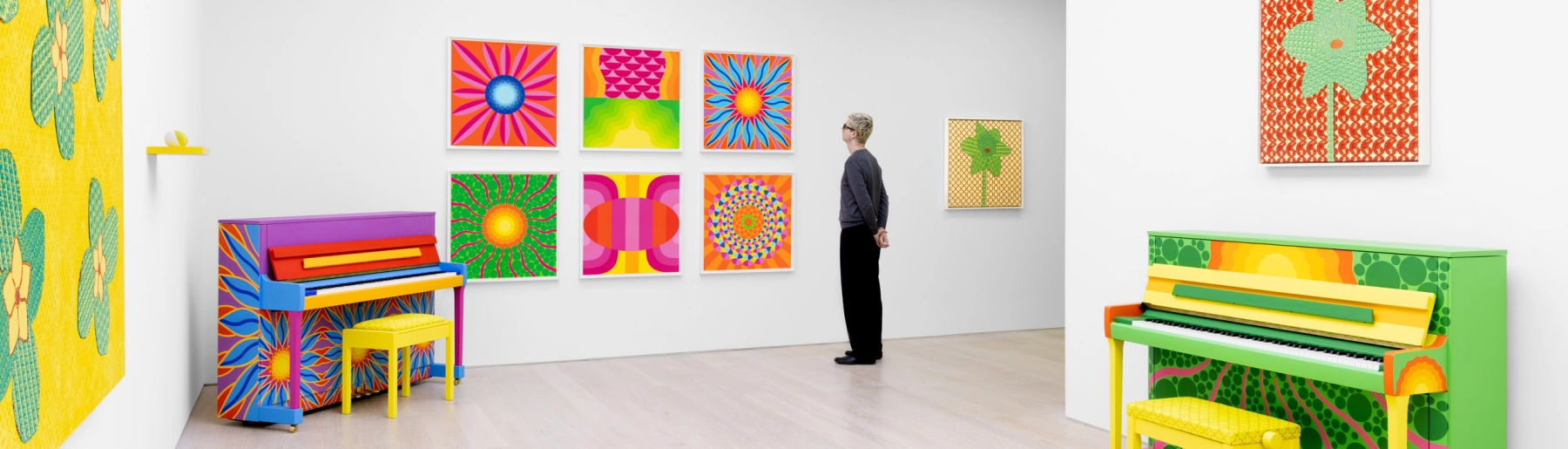
Yinka Ilori: Joy Through Resistance. He Who Laughs Last, Laughs Best
Event description
Over the past decade, Ilori has developed a truly multi-disciplinary practice, blending expertise in architecture, sculpture, furniture, and both interior and graphic design. Often utilising the city as a canvas, his murals, pavilions, and architectural interventions are celebrated for fostering a deep sense of community. Rooted in themes of joy and optimism, Ilori’s work leverages the power of storytelling to bridge divides, fostering meaningful connections between individuals and the world around them.
Yinka Ilori: Joy Through Resistance represents Ilori’s most personal presentation to date, featuring over 20 new and recent works across painting, print, sculpture, and an immersive sound installation. Inspired by his British Nigerian heritage and the vibrant energy of communal gatherings, the exhibition serves as a narrative of joy through resistance. By weaving together floral motifs, the cultural symbolism of lace, and the rhythmic presence of musical instruments, Ilori explores the defiance required to push back against racial discrimination and societal barriers - ultimately celebrating the power of transforming hardship into communal strength and uplift.
New and recent prints and paintings are inspired by the universally recognised symbol of the flower. Paradise for All, 2024, a group of six screenprints is characterised by a use of bold, vivid colours and strong geometrical forms. Seen alongside a second group of flowers entitled, An Abundance of Flowers blessed by us, for us, 2026, this body of work draws on a shared global spirituality.
In a dialogue between his dual identities, Ilori depicts Nigeria’s national flower, the Costus spectabilis (known as the yellow trumpet), alongside the common daffodil, native to the UK. He leans into the inherent paradox of the floral form - historically serving as both a decorative motif and a symbol of life’s brevity. In a contemporary social context, he explores how flowers act as a universal vessel for emotion, offered with equal weight during moments of both profound joy and sadness.
The yellow trumpet flower blooms in clusters, illuminating the ground. Continuously generating new shoots and roots, this cheerful, resilient flower represents the enduring strength of community. The yellow daffodil, one of the most popular flowers in the UK, is believed to have originated in Ancient Rome, when daffodils were planted in memory of loved ones. The robust nature of the bud, much like the yellow trumpet, means the daffodil can blossom consistently for decades as bulbs naturalise and bigger displays are created over time.
Ilori depicts the flora layered over patterns taken from ornamental lace designs. He unites these symbols to weave together diverse stories from the global diaspora. In the West African diaspora and beyond, lace or Swiss voile is commonly used in ceremonial and church attire, an intrinsic element of personal style, identity, and pride, representing both refinement and resilience.
Ilori states “This exhibition is my most personal to date - a reflection of my own story and the resilience of the diaspora. By layering the Nigerian yellow trumpet and the British daffodil over ornamental lace, I’m exploring how we transform hardship into strength.
These works are about more than just beauty, they are about the ‘quiet resistance’ found in our traditions and our ability to blossom consistently, even in the face of struggle.
I am incredibly proud to debut this journey with Cristea Roberts Gallery in London and invite the community to experience this space of joy and power.”
Through sculptural objects and a sound installation, visitors are invited into a space of worship where traditional instruments, including handmade congas, a vibrant custom-made shekere, and a drumkit, are enveloped in lace. The drum is deeply significant to Ilori. He learned to play it as a child in church, teaching himself percussion. Rooted in centuries-old traditions, drumming stands as a symbol of hope, peace, and joy, embodying a strength forged through resistance. A non-violent form of resistance, the beating of drums was also a powerful tool for communication, historically used by enslaved Africans to coordinate rebellions.
Persisting today in social movements and religious rituals and festivities, Ilori selects these instruments for their ability to both disrupt and foster unity. He is fascinated by the contradiction between the heavy, resonant pulse of drumming and the weightless fragility of the textile. By wrapping these instruments, he draws attention to the vulnerability of joy, recognising that the very celebrations these sounds represent are precious and can be threatened at any moment.
The sound installation, which features two new pieces of music, has been developed in response to Ilori’s new work. Composer and musician Peter Adjaye has created a piece of music that unfolds in three parts, featuring horns and brass instruments. This soundwave, which rises and falls, oscillates between joy and resilience, celebration and warning.
The second piece of music by composer and producer James William Blades incorporates field recordings, Yoruba lullabies, church songs, and linguistic training records, alongside Nigerian blow horn samples. Rooting the composition in cultural memory, the music also explores the full spectrum of colour within Ilori’s work.
Gallery director David Cleaton-Roberts, states “It has been a pleasure working with Yinka over the past three years, and to be staging his first solo exhibition at the gallery. Yinka’s ideas have found a consistent vehicle of expression through his unique large-scale projects and collaborations around the world.
We are delighted to now champion the vitality and inventiveness of his important practice in the setting of our gallery space, and for audiences to engage and connect with this thought-provoking body of work.”
Yinka Ilori MBE (b. 1987) is a multi-disciplinary artist and designer who specialises in storytelling, fusing a bold visual language, and his British Nigerian heritage to convey new narratives through contemporary art and design. Ilori’s work has been showcased globally through solo and group exhibitions, public commissions and set and exhibition design.