

Event Details
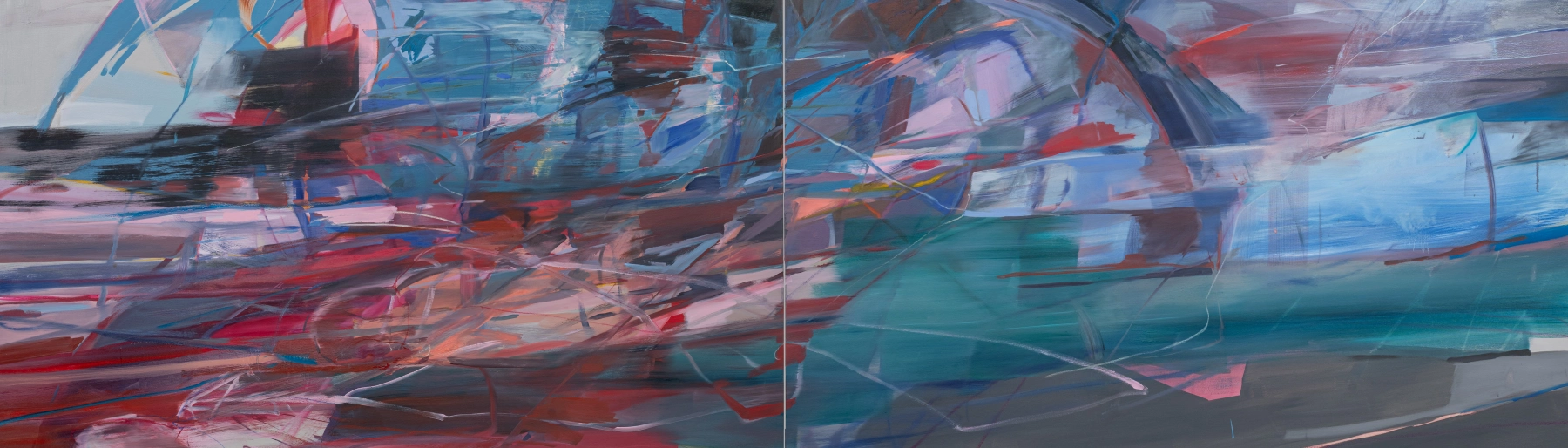
H.E. Morris: Songs of War
Event description
‘Songs of War’ by Matthew James Holman
Napalm and black clouds emerging in newsprint
Flesh soft as a Kansas girl’s
ripped open by metal explosion—
three five zero zero on the other side of the planet
caught in barbed wire, fire ball
bullet shock, bayonet electricity
bomb blast terrific in skull & belly, shrapneled throbbing meat
— Allen Ginsberg, ‘Wichita Vortex Sutra’
Many of the titles of H. E. Morris’ most recent body of work are taken from and inspired by Homer. When I visited her studio, she reminded me of the first lines of The Odyssey, from which she borrowed the name of her present exhibition: ‘Sing in me, Muse, and through me tell the story / of that man skilled in all ways of contending, / the wanderer, harried for years on end, / after he plundered the stronghold / on the proud height of Troy.’ As I looked up at her new large-format works, I was struck by the fact that Homer’s epic does not begin with victory but with its multitudinous costs, with wandering, endurance, loss of companions, the desperate desire for homecoming. Looking at Morris’ abstractions, paintings of an altogether different time, a time exceeding the mechanised warfare of the last century, with death now fully automated and delivered by drone or airstrike, I felt the same displacement: these are paintings that know nothing of triumph, that begin, as The Odyssey does, in the long aftermath, among the scattered and the harried. Whatever strongholds existed before these pictures have already fallen and what remains is gesture, surface, and those white scratched lines that cross the field of colour like a man still moving through wreckage, rifling through the debris for signs of home. Whether narrative or visual, figurative or abstract, the topos of war is shaped by ancient and modern modes of destruction and the catastrophic consequences of conflict on human lives and cultures, and on a scale at once individual and incalculably collective even as new narratives are produced by the rapid march of modern technology. I looked at what seemed like the aftermath of an atrocity but felt alienated from the subject, seeing only viscera without the bodies.
Writing on Cy Twombly’s sculptures, Mary Jacobus claims that even though they might be centred around ‘Homer's founding narrative of the ten-year war between the Achaeans and the Ilians with its “roll call of death”’, she sought to use ‘the mythos of the ancient world to reinterpret war from the perspective of [Twombly’s] own (and our) historical moment’—and I think this holds true for Morris, too—questioning the perception of the artist as ‘an expatriate American, isolated from politics and removed from the events of his [or her] time and country.’ Like Twombly, Morris’ apparent withdrawal from the contemporary world is deceptive: her work carries a sustained commentary on war and its memorial culture, one sharpened rather than blunted by its classical address. The full emotional spectrum of conflict—glory and shame, desire and devastation, loyalty and annihilation—recurs across every era, from Homer to the present. The monsters are always the same monsters. They persist into what has been called the era of permanent conflict, wearing new faces. Morris’ paintings are about war, but they are non-representational insofar as they draw attention to the materiality of their composition, to gesture and worked-upon surface, and do not immediately signal themselves as sites of conflict even, or especially, as the composition signals the energy of conflict and tension. Yet our tendency to find categories of nature or figure outside itself is hard to suppress. In The Edge (all works 2026), the arching blue-grey forms in the upper register read, to my eye at least, as fuselage, cockpit, arcing drone, perhaps even the curved body of aircraft, while the lower half dissolves into what looks like wreckage: red and pink masses that could be flesh or fire or both. The teal band at the lower right holds just steady enough against the chaos above it to create an unsettling calm.
One suspicion that might befall an artist whose subjects deal with war in the first quarter of the twenty-first century concerns that artist’s stakes in the game. What gives a painter the right to this subject? If you weren’t there, and so were excused from the smoke reaching your lungs, or if the sound didn’t split your skull, then what exactly are you recording? Is the canvas a witness or a presumption? Can an artist, locked away in the studio, know anything true about a body that has known the field? And if distance is inevitable, if the war is always somewhere else, always mediated through a screen or a headline or someone else’s testimony, then does that distance disqualify the artist, or is it precisely the condition they’re working with? In another age, Jacques-Louis David’s perhaps, distance from the battlefield may preclude an understanding of it, but today the war arrives unbidden, at speed, collapsed into two dimensions in the palm of your hand. John Berger understood that the proliferation of images doesn’t produce knowledge, as the Enlightenment thought it might, but instead produces a kind of anaesthesia, a numbing through repetition in which the photograph of a body becomes interchangeable with the photograph of a meal.
The artist who turns away from documentation and toward paint makes a counter-proposal: that slowness, that resistance to the instantaneous flow of trauma, might restore singularity to what the feed has already dissolved into numbed spectacle. I see Morris’ works in this vein: these are not paintings of Khan Younis, or the Greater Upper Nile, or Donetsk, and that might reasonably trouble our sense of her ‘right’ to the subject, but they are meditations on the ambient alienation that is felt (and that has been felt from Homer, who never sang from the fields of Troy, to Picasso, who painted Guernica on the rue des Grands-Augustins) as the world descends into a cruel kind of madness. The artist, classical or modern, who is thus closest to Morris’ sensibility is Nancy Spero, especially as evidenced in her War Series, sometime between 1966 and 1970, rendered in gouache and ink on handmade Japanese paper while Vietnam burned on American television. The series is neither heroic nor documentary in its ambitions. What is striking, in relation to Morris, is how Spero arrived at her formal language: ‘When I did the War Series I felt, at a primitive level, that if I revealed all this nastiness in some way to the world, then I would be exorcising the evils.’ Spero’s is a shamanistic approach to war; her postcard guards Morris’ studio doorway. The studio, for Spero, was a site of witness and of rage, and she used spit to thin her gouache, rubbed and patched the paper until it bore the physical evidence of its own making. The work was intimate in scale and apocalyptic in content: phallic bombs, anthropomorphic helicopters, severed heads dangling from a maypole, blood, guts. Leon Golub, writing about the War Series in 1967, caught something of its specific logic: ‘The whirlybird becomes the Beast of the Apocalypse, the machine becomes the technological equivalent for metaphysical nightmare... The eschatological is as real as a Chrysler or a tank.’ That collapse of the ancient and the contemporary—eschatology reimagined as a Chrysler—recalls my first interaction with Morris’ abstractions, as they reach back into Homer’s age and wink at the present.
I’d like to end with the pictures themselves. These are paintings that feel so painterly, by which I mean the oil has seeped into the linen in such a way that we can almost imagine the gyrations of the mark-making, the kinetic force of movement being tracked across the surface, and are yet jagged and anti-painterly, recalling the matrixial networks that populate those abstracted algorithms that collect data for war. There is something in the geometry of these lines, something in their angularity, the way they intersect and override one another without settling into composition, that reads like the visual logic of a system: a targeting grid, a flight path rendered as data, or the overhead drone image, the satellite photograph, the digital map overlaid with strike zones. War as a set of coordinates. They are clearly hand-drawn, clearly the product of a body in front of an object and the residue an outcome of that confrontation, and yet their coldness, or perhaps more specifically their refusal of the lyrical arc, gives them the quality of data that has been translated back into paint, as though the algorithm had been run in reverse.
In Captured, the raw linen is left exposed across much of the canvas, a deliberate withholding: the ground shows through the event, and the white lines that bend and cross the picture-plane, appearing to do nothing less than score it, like trajectories recorded after the fact. In A Common Fate, the dense red mass at the centre, that Bacon-esque swollen mass, a folded form that might be a torso, might be a hull, or the interior of something ruptured. You can feel the figure pressing against the abstraction from inside, and the abstraction refusing to give way. This is where Morris comes into her own, straddling an ancient story of men harried across a sea and the automated violence that now crosses no distance at all. The scratched white lines feel ballistic, and the tonic of the linen ground offers a sombre touch. Somewhere in these paintings, that restless wanderer may still be moving, but that might be asking the wrong question of the wrong picture. These are songs of war, laments for a future that might not come.